Translation of the Spanish original. If there are differences, the Spanish version prevails and, above all, the linked official rule.
France has no specific law on motorhomes. A motorhome is a vehicle and may park wherever any other vehicle can, as long as it is not dangerous, a nuisance or abusive. Each mayor can limit the parking of certain vehicles and ban camping in some areas with a municipal order (arrêté), so always check the municipality and the signs.
Information reviewed by RutasCamper on 6 November 2026.
Parking
- A motorhome may park like any vehicle if the parking is not dangerous, a nuisance or abusive (Code de la route, arts. R417-9 to R417-13).
- It is abusive to leave the vehicle in the same place on the public road for more than seven days in a row, or less if a local authority order sets so (art. R417-12). It is a 2nd-class contravention.
- In tourist zones delimited by the local authority, a badly parked vehicle of 20 m² or less becomes abusive if it is still there more than two hours after the report (art. R417-13). It is a 4th-class contravention.
- If you are not there or do not move it when asked, the vehicle may be immobilised and taken to the pound (arts. R417-12 and R417-13).
Sleeping inside the vehicle
- No national text we have read bans sleeping inside a properly parked vehicle as such, but the mayor can limit parking, and if there are signs of camping, the camping rules apply.
- The law contains no «right to stay overnight». A 2004 government circular recommends that prefects limit bans to sensitive areas and preserve a night stop somewhere in the municipality, but it is a recommendation, not a binding rule.
What the mayor can ban
- By a reasoned order, the mayor can regulate the stopping and parking of vehicles or of certain categories of them, and ban access to some roads (Code général des collectivités territoriales, art. L2213-2).
- The mayor can also ban vehicle access to roads or zones to protect natural areas, landscapes or quiet (art. L2213-4).
- According to the Government, if an order applies only to one type of vehicle, it must define its characteristics precisely, and except in exceptional circumstances a general and absolute ban across the whole municipality is not allowed (circular of 19/10/2004; Senate replies published in 2020 and 2025).
Camping
- Camping is freely practised away from roads and public ways, with the agreement of whoever has the use of the land and unless the owner objects (Code de l'urbanisme, art. R111-32).
- Isolated camping is banned, with exceptions, on the seashore, in classified or listed sites, in protected heritage areas, near historic monuments and within 200 m of drinking-water intakes (art. R111-33).
- The mayor can ban camping outside campsites in certain areas. The ban is only valid if it is posted at the town hall and signed at the access points (art. R111-34).
- The Code de l'urbanisme regulates caravans (art. R111-47). We have not found a current article that says expressly whether a motorhome is a caravan for these purposes.
Beaches and dunes
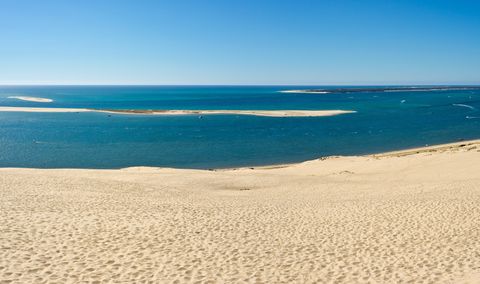
- Driving and parking motor vehicles outside the permitted tracks is banned on the seashore and on public dunes and beaches open to the public, unless authorised by the prefect (Code de l'environnement, art. L321-9).
Fines
- Breaking a municipal order is, in general, a 2nd-class contravention (Code pénal, art. R610-5), with a fine of up to €150 (art. 131-13). Depending on how the order is worded, another rule may apply, such as the Code de la route.
- Maximum amounts by class of contravention (Code pénal, art. 131-13): 2nd class, €150; 4th class, €750.
- Contraventions under the Code de la route can be handled with a fixed fine (amende forfaitaire) (Code de procédure pénale, art. R48-1): €35 for 2nd-class ones and €135 for 4th-class ones (art. R49). There are also reduced amounts for quick payment and increased amounts for non-payment, which we have not checked.
National parks
- In the core of several national parks (Écrins, Mercantour, Vanoise, Pyrénées and Cévennes) camping is banned, also inside the vehicle, unless authorised or in the places each park allows (in the Cévennes there are areas authorised for one night); in Calanques and Port-Cros, camping and bivouacking in any form are banned. See the page of each region.